CFChooseField
Transportation and Logistics

Air Traffic Controllers

Control air traffic on and within vicinity of airport, and movement of air traffic between altitude sectors and control centers, according to established procedures and policies. Authorize, regulate, and control commercial airline flights according to government or company regulations to expedite and ensure flight safety.
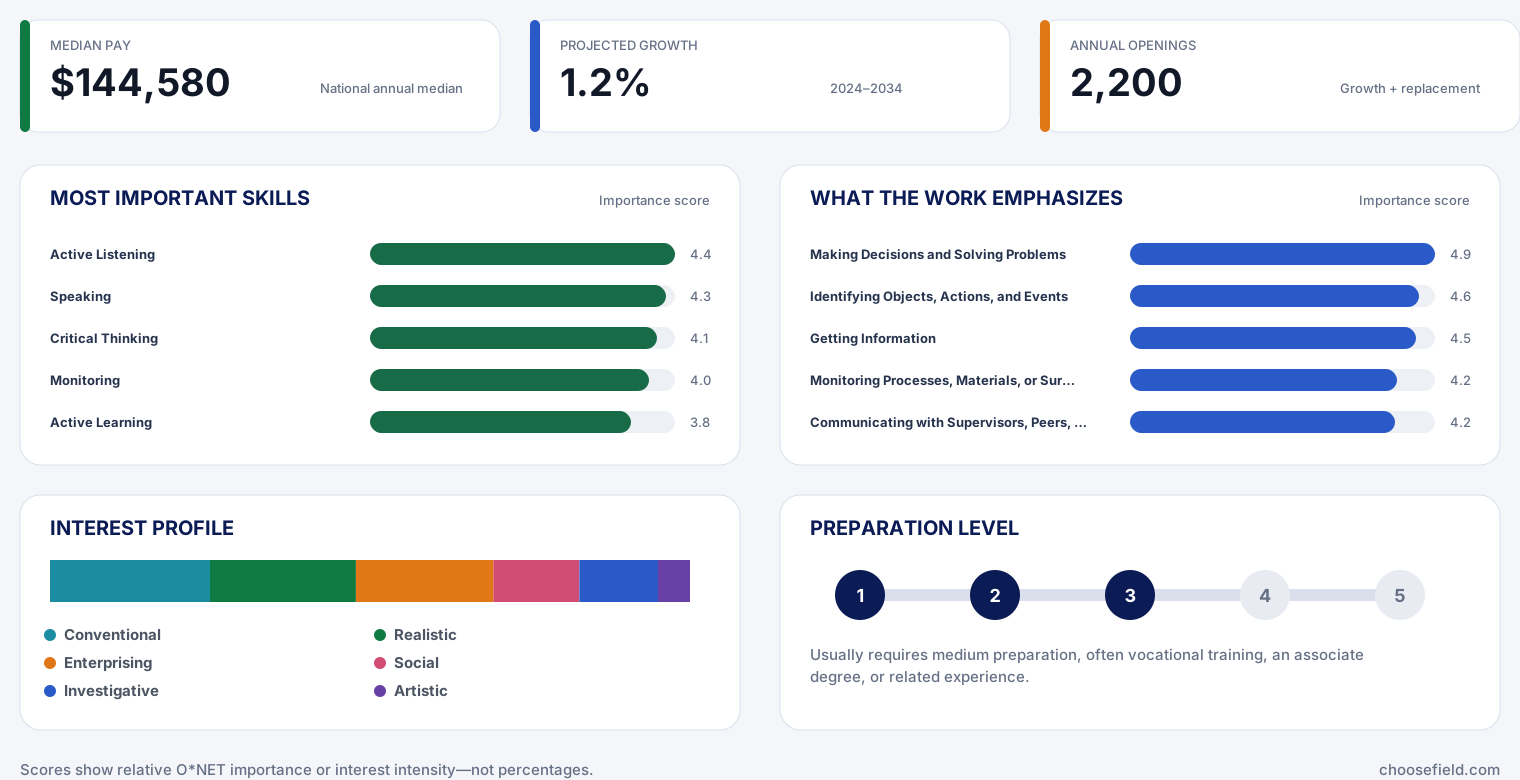
Visual summary of pay, outlook, skills, interests, and preparation for Air Traffic Controllers

Median pay

$144,580
Median annual pay for Air Traffic Controllers.
U.S. Bureau of Labor Statistics · 2024
View source ↗

10-year growth

1.2%
Projected employment growth from 2024 to 2034.
U.S. Bureau of Labor Statistics · 2024–2034 projections
View source ↗

Annual openings

2,200
Projected annual openings, including growth and replacement demand.
U.S. Bureau of Labor Statistics · 2024–2034 projections
View source ↗

Employment

24,100
Estimated U.S. employment for Air Traffic Controllers in 2024.
U.S. Bureau of Labor Statistics · 2024
View source ↗

Jobs added or lost

+300
Projected numeric employment change from 2024 to 2034.
U.S. Bureau of Labor Statistics · 2024–2034 projections
View source ↗

Entry preparation

Associate's degree
Typical additional preparation: Long-term on-the-job training.
U.S. Bureau of Labor Statistics · 2024 profile
View source ↗
O*NET occupation profile

What the work involves

Strongest O*NET signals first.

Essential skills

  1. 1Active Listening
  2. 2Speaking
  3. 3Critical Thinking
  4. 4Monitoring
  5. 5Active Learning
  6. 6Reading Comprehension

Knowledge areas

  1. 1Transportation
  2. 2English Language
  3. 3Public Safety and Security
  4. 4Education and Training
  5. 5Customer and Personal Service
  6. 6Geography

Abilities

  1. 1Problem Sensitivity
  2. 2Oral Comprehension
  3. 3Oral Expression
  4. 4Selective Attention
  5. 5Deductive Reasoning
  6. 6Flexibility of Closure

Career interests

  1. 1Conventional
  2. 2Realistic
  3. 3Enterprising
  4. 4Social
  5. 5Investigative
  6. 6Artistic

Work styles

  1. 1Attention to Detail
  2. 2Cautiousness
  3. 3Self-Control
  4. 4Stress Tolerance
  5. 5Dependability
  6. 6Integrity

Work activities

  1. 1Making Decisions and Solving Problems
  2. 2Identifying Objects, Actions, and Events
  3. 3Getting Information
  4. 4Monitoring Processes, Materials, or Surroundings
  5. 5Communicating with Supervisors, Peers, or Subordinates
  6. 6Processing Information

Work context

  1. 1Frequency of Decision Making
  2. 2Indoors, Environmentally Controlled
  3. 3Importance of Being Exact or Accurate
  4. 4Impact of Decisions on Co-workers or Company Results
  5. 5Work With or Contribute to a Work Group or Team
  6. 6Contact With Others

Representative tasks

  • Inform pilots about nearby planes or potentially hazardous conditions, such as weather, speed and direction of wind, or visibility problems.
  • Issue landing and take-off authorizations or instructions.
  • Transfer control of departing flights to traffic control centers and accept control of arriving flights.
  • Provide flight path changes or directions to emergency landing fields for pilots traveling in bad weather or in emergency situations.
  • Alert airport emergency services in cases of emergency or when aircraft are experiencing difficulties.
  • Monitor or direct the movement of aircraft within an assigned air space or on the ground at airports to minimize delays and maximize safety.
  • Direct pilots to runways when space is available or direct them to maintain a traffic pattern until there is space for them to land.
  • Monitor aircraft within a specific airspace, using radar, computer equipment, or visual references.

Software and tools

Microsoft PowerPoint · in demandMicrosoft Outlook · in demandMicrosoft Office software · in demandMicrosoft Excel · in demandAdobe Acrobat · hot technologyMicrosoft Word · hot technologySAP software · hot technologyMicrosoft Access · hot technologyFlight simulation softwareExpedite departure path EDP softwareEn route descent advisor EDADirect-to-tool software

Sources

BLS provides national pay, employment, and projections. O*NET provides skills, interests, preparation, tasks, work context, and tools.